Goofy Had 2 Operations
Goofy had Cranial Cruciate ruptures and torn Cruciate ligaments in both of his hind legs. Dr. John Tuomi (with the Palmer Veterinary Clinic) diagnosed Goofy's condition and performed the surgeries. Dr. Tuomi graduated from Colorado State University in 1978 and has been in practice ever since.
Goofy's ligaments were injured, stretched and there was no elasticity in the
knee. For a couple of months it only bothered him if he ran or walked for an
extended period of time, but then gradually became worse and started to bother
him on a daily basis. There were days when he only laid by the couch
motionless.
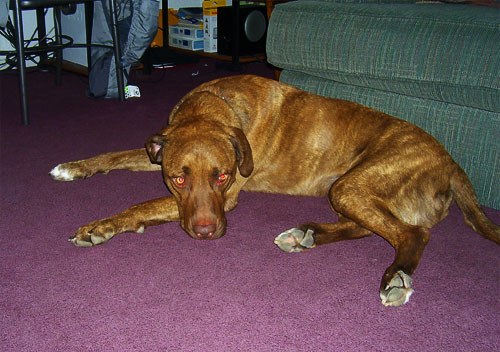
He was being medicated with 75 mg of
Rimadyl twice daily.
Operation Descriptions
Cranial Cruciate Rupture
The first report of a cranial cruciate ligament rupture in the dog was in 1926, but it was not until the 1950s that the first report of surgical correction was described. Since then, numerous surgical techniques for repair of the cranial cruciate-deficient knee have been reported in the literature.(1) Selection of a technique for repair of the cranial cruciate- deficient knee should be based upon numerous criteria including size, age, and function of the dog, chronicity of the injury and surgeon preference. Repair techniques are classified as extra-articular and intra-articular. Extra-articular repairs are those that stabilize the joint from outside of the joint capsule and include fascia lata imbrication, lateral retinacular imbrication (DeAngelis suture), and fibular head transposition. Intra-articular techniques use some sort of graft material to anatomically replace the cranial cruciate ligament
All surgical procedures for CCL instability begin with a
thorough exploration of the stifle joint through a lateral parapatellar
approach. All intra-articular structures are examined. The most common injury
coexisting with a CCL rupture is a tear in the caudal horn of the medial
meniscus (discussed later). The caudal cruciate ligament (CaCL) and collateral
ligaments are also examined, as well as the tendons of the long digital extensor
and popliteus. The remaining stumps of the ruptured CCL and any remaining intact
CCL are removed. It is assumed that the remaining intact CCL either is damaged
or will become completely ruptured if left. If the caudal horn of the medial
meniscus is damaged, only the damaged portion is removed.
*Information found at
Vin.Com
Anterior Cruciate Ligament
ACL (Anterior Cruciate
Ligament) surgery in dogs is a commonly done surgical procedure in veterinary
practice. When the anterior cruciate ligament is torn or stretched, instead of
moving like a hinge, the knee joint will actually make a sliding motion. This
Healthy, strong dogs can tear an ACL...abnormal motion and instability creates
trauma within the joint that leads to wearing of cartilage, increased synovial
fluid production and inflammation. Eventually, DJD... degenerative joint
disease... results.
A torn cruciate ligament can occur in any dog if just the right (or wrong!)
forces impact the knee joint. Most commonly seen in larger breeds of dogs and in
dogs that are overweight, the ACL surgical procedure does not actually repair
the torn ligament but rather replaces the ligament with artificial material that
takes over the function of the Anterior Cruciate Ligament. In the case presented
below, nylon strands of 80 pound tensile strength are utilized to restabilize
the kneeA radiograph of a normal knee... (stifle) joint.
The veterinarian may tell the dog's owners that the dog has a torn Anterior
Cruciate Ligament and one of the best ways to get him back to full function
would be to do a surgical procedure where an artificial ligament is placed along
the side of the knee joint; we don't try to fix the torn ligament because that
particular one just won't heal properly. So we fool the knee into thinking that
there is a ligament. After a few weeks of confinement, and then controlled
activity, the fibrous connective tissue buildup along the artificial strands
implanted along the knee joint stabilize the joint during activity. Then your
dog can begin using the leg properly.
*Information found at
ThePetCenter.Com